← Back to TCM Global · All articles
2026-10-20
# IH901: The Gut Metabolite Behind Ginseng's Anti-Tumor Effects
For centuries, ginseng has held a place of quiet reverence in Eastern wellness traditions—a root prized not for quick results, but for its slow, grounded support of the body's own vitality. Modern science has begun to illuminate why this ancient botanical has earned such lasting respect. At the center of that story is a compound you may not have heard of: IH901, a gut metabolite formed when the body's microbiome processes ginsenosides. Understanding IH901 offers a more complete picture of how ginseng may work within the body—not as a single active ingredient, but as a collaborative relationship between plant and gut.
Ginsenosides are the signature compounds found in ginseng. They are a class of triterpenoid saponins, and they vary across species and preparations—Panax ginseng, Panax quinquefolius, and red versus white ginseng each carry their own profile. Traditionally, these compounds were understood only through the effects they produced. Today, researchers recognize them as the root's primary bioactive constituents.
Yet ginsenosides are not easily absorbed in their native form. Their molecular structure is large and water-soluble, which limits how readily they pass through the intestinal wall. Nature, it seems, designed ginseng to depend on a partner: the gut.
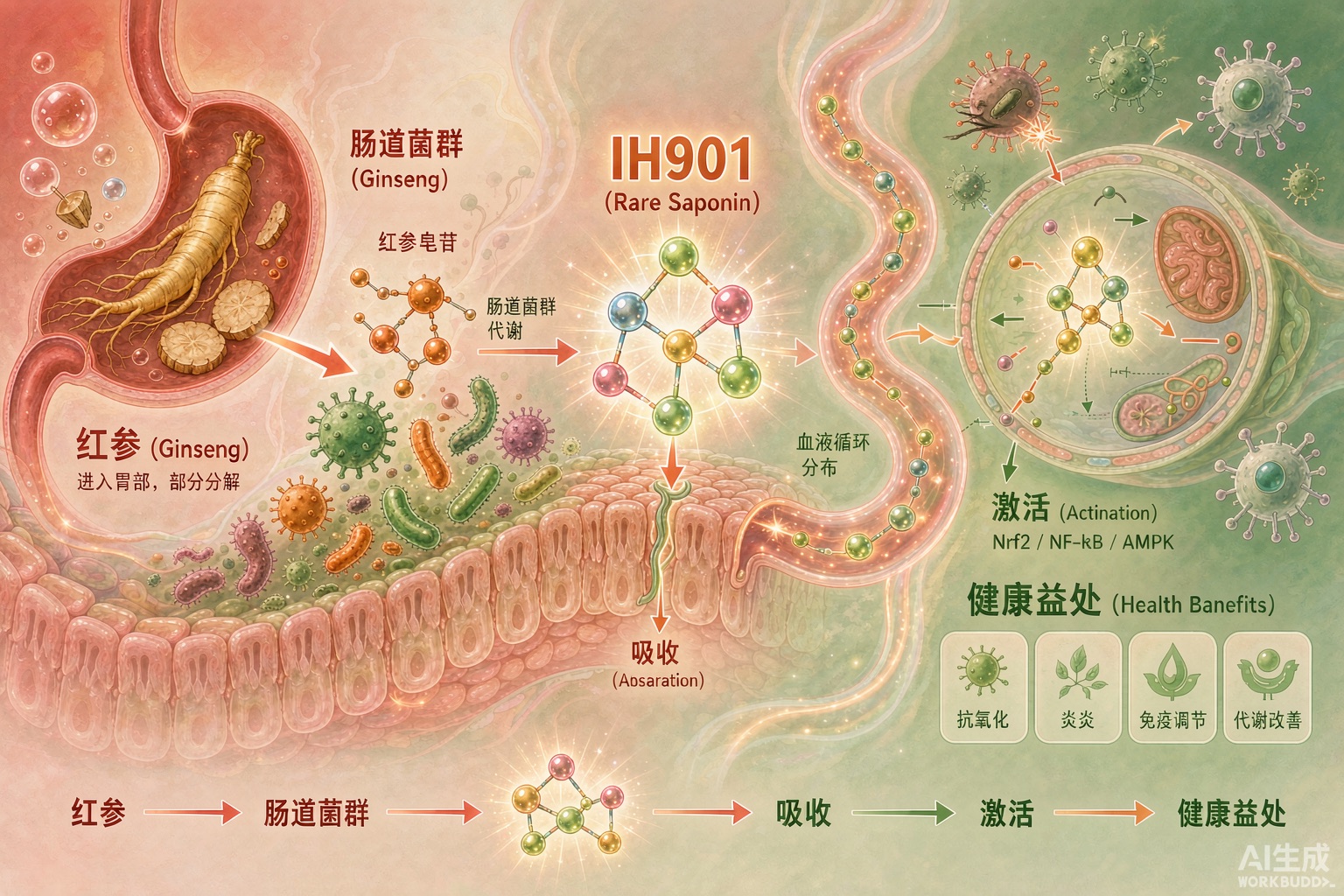
The human gut hosts trillions of microorganisms that act as a kind of internal alchemy lab. When ginsenosides reach the lower intestine, certain bacteria—particularly species with glycosidase activity—begin to cleave off sugar molecules, converting the original compounds into smaller, more absorbable forms. This process, known as biotransformation, produces a family of secondary metabolites, and compound K and IH901 are among the most studied.
This is where the Eastern concept of *bencao*—the living relationship between body and botanical—meets modern microbiome science. In traditional thought, a remedy was never considered in isolation; its effect depended on the constitution of the person taking it. The research on gut metabolites reflects something remarkably parallel: ginseng's impact may depend less on the root alone and more on the ecosystem of the person who consumes it.
IH901 is a gut metabolite derived from protopanaxadiol-type ginsenosides after microbial processing. In laboratory and preclinical research, IH901 has drawn attention for its interaction with cellular pathways associated with stress response and abnormal cell growth regulation. Scientists have observed that these metabolites can influence signaling processes in cells in experimental settings.
It is important to be clear about the boundaries of this knowledge. Most of what we understand about IH901 comes from laboratory and animal research, not from broad human clinical trials. For wellness purposes, it represents an encouraging direction of inquiry—a scientific lens on a traditional practice—rather than a promise. TCM Global presents this information in the spirit of education and holistic understanding, not as a substitute for professional medical guidance.
Thinking in terms of metabolites shifts how we approach ginseng. If the gut converts ginsenosides into forms like IH901, then gut health becomes part of the wellness equation. A balanced, diverse microbiome—supported by fiber-rich foods, fermented ingredients, and mindful eating—may be a meaningful companion to any botanical practice. Traditional Chinese wellness has long emphasized digestive harmony as the foundation of vitality, and this research offers a modern echo of that principle.
It also suggests that preparation and consistency matter. Regular, moderate use of ginseng—rather than occasional dosing—aligns with both traditional guidance and the gradual nature of microbial conversion and absorption.
For those drawn to ginseng, quality and authenticity are worth prioritizing. Whole roots, properly processed and sourced with care, preserve the full spectrum of ginsenosides that the gut can then transform. TCM Global's curated ginseng selections are chosen with this philosophy in mind—respect for the root, and respect for the body that receives it.
The IH901 story is a gentle reminder of something traditional medicine has always understood: the body is not a passive recipient, but an active participant. Ginseng, through its interaction with the gut, becomes a living conversation. Science will continue to explore where that conversation leads. For now, we are left with a quiet appreciation for the wisdom of the root—and the invisible world inside us that helps bring it to life.
*This article is for educational and wellness purposes only and does not constitute medical advice. Consult a qualified professional regarding any health concerns.*
Explore more Eastern wellness wisdom at TCM Global.