← Back to TCM Global · All articles
2026-10-18
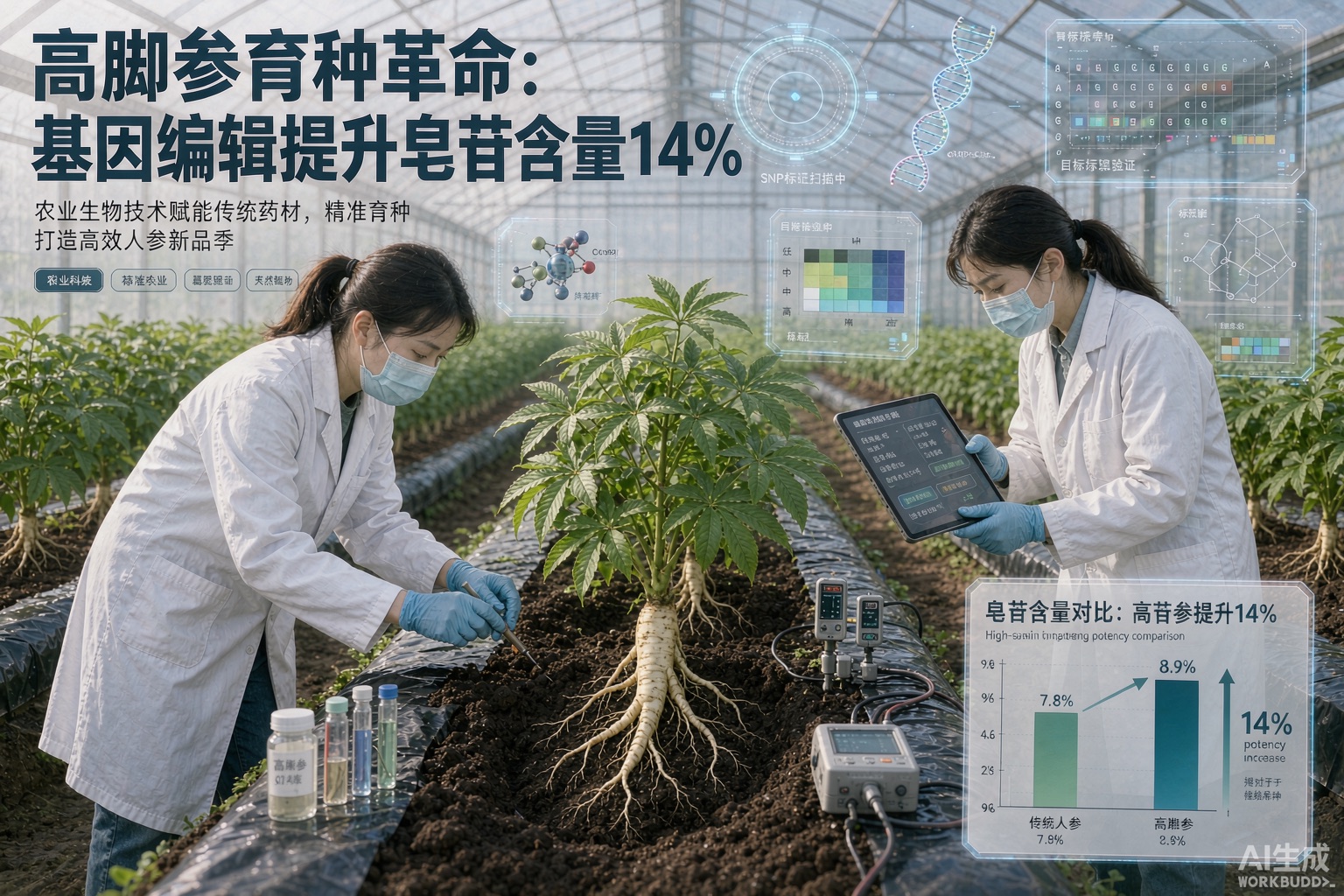
For centuries, ginseng has held a quiet, steady place in Eastern wellness traditions—prized not for quick effects, but for its patient, grounding character. In recent years, science has sought to understand that reputation through its most studied constituents: ginsenosides, the saponins that give the root much of its identity. Now, a meaningful breeding advance has drawn fresh attention to high-saponin ginseng cultivars, with reported gains of roughly 14 percent in total saponin content. Here is what that development means, and why it matters for anyone who values ginseng as part of a considered wellness routine.
Ginsenosides are the secondary metabolites found in *Panax* species. They are the compounds most referenced in cultivation research, quality grading, and botanical analysis alike. When growers and formulators speak of a root being "rich" or "mature," saponin content often sits quietly behind that judgment.
From a wellness perspective, these compounds are best understood as markers of a well-grown, carefully handled root. A higher total saponin figure is not a promise of any specific outcome—it is a signal of quality. It reflects lineage, soil, age at harvest, and the patience applied throughout cultivation. In that sense, saponin content is a practical bridge between traditional regard for ginseng and modern standards of consistency.
Traditional ginseng cultivation is slow by nature. Seed viability is delicate, roots mature over four to six years, and reliable output depends on careful stewardship across seasons. Selective breeding programs adapted from other crops have gained traction in ginseng only gradually, largely because the plant resists speed.
The recent advance rests on systematic selection rather than shortcuts. Researchers worked through successive generations, identifying parent plants with consistently stronger saponin profiles, then crossing and evaluating offspring across controlled and field conditions. The cumulative result was an average lift of about 14 percent in total saponins relative to established commercial cultivars in comparative trials.
What makes the figure notable is its nature: it is an aggregate gain across the root, not a single ginsenoside amplified at the expense of others. Balanced profiles tend to be the hallmark of well-regarded ginseng—the whole root carries more meaning than any isolated fraction.
The 14 percent is the visible result of years of quiet iteration. In a category that resists acceleration, that kind of progress is meaningful precisely because it is so hard to achieve.
A cultivar, however promising, is only a starting point. Soil composition, elevation, shade management, harvest timing, and post-harvest drying all shape the final saponin profile. A superior genetic line planted in tired soil or harvested too early will disappoint; a modest line grown with craft often overperforms.
This is why credible ginseng provenance speaks in specifics: region, root age, gentle drying methods, and batch-level analysis. Improved cultivars raise the ceiling on quality—they do not replace the discipline required to reach it.
For those who incorporate ginseng into an everyday wellness rhythm, the practical takeaways are simple:
Better cultivars give cultivators a stronger raw material. They also give thoughtful buyers and blenders more to work with—whether in a gently steeped root tea, an extract, or a carefully formulated blend. The breakthrough is not a revolution in what ginseng is; it is a refinement of how faithfully it can be delivered.
Eastern tradition has always treated ginseng as a long game: grown slowly, harvested judiciously, consumed with consistency. Modern breeding, at its best, honors that rhythm rather than overriding it. The reporting around high-saponin ginseng cultivars—a 14 percent lift in total saponins achieved through patient selection—fits neatly within that frame. It is a botanical achievement and a reminder that quality, in ginseng, is grown rather than manufactured.
If you follow developments in botanical wellness, this is one worth monitoring—not for overnight change, but for the quiet improvement it brings to the root that traditions have trusted for generations.
Explore more Eastern wellness wisdom at TCM Global.