← Back to TCM Global · All articles
2026-10-20
Traditional Chinese medicine has long spoken of ginseng (Ren Shen) as a root that "calms the spirit and strengthens the qi." Modern cell biology offers a different vocabulary for the same respect. Today, researchers studying ginsenoside Rb1—one of the principal active saponins in Panax ginseng—are asking how this molecule might shape the behavior of immune cells, particularly through a signaling route known as the PI3K-AKT pathway. The conversation is technical, but its tone is not unlike the traditional one: measured, curious, and attentive to balance.
This article is written in a wellness context. It is not medical advice, and it makes no claims about treating or preventing disease. Instead, we explore how contemporary science is framing a familiar botanical, so you can appreciate it with both curiosity and calm.
Macrophages are the body's resident housekeepers—cells that sense their surroundings, clear debris, and help coordinate the wider immune conversation. They are remarkably adaptable, shifting between functional states depending on the signals they receive.
One widely studied state is the M2 phenotype. In wellness terms, M2 macrophages are often associated with resolution and repair—the tidy-up crew that follows a period of activity. The process by which a macrophage adopts this state is called M2 macrophage polarization.
Research interest lies not in labelling M2 as "good" or "bad," but in understanding how polarization is steered. Many tissues—including those where chronic, low-grade disturbance is present—show shifts in macrophage states. Learning what influences those shifts is a question of balance, which is where the PI3K-AKT pathway enters the story.
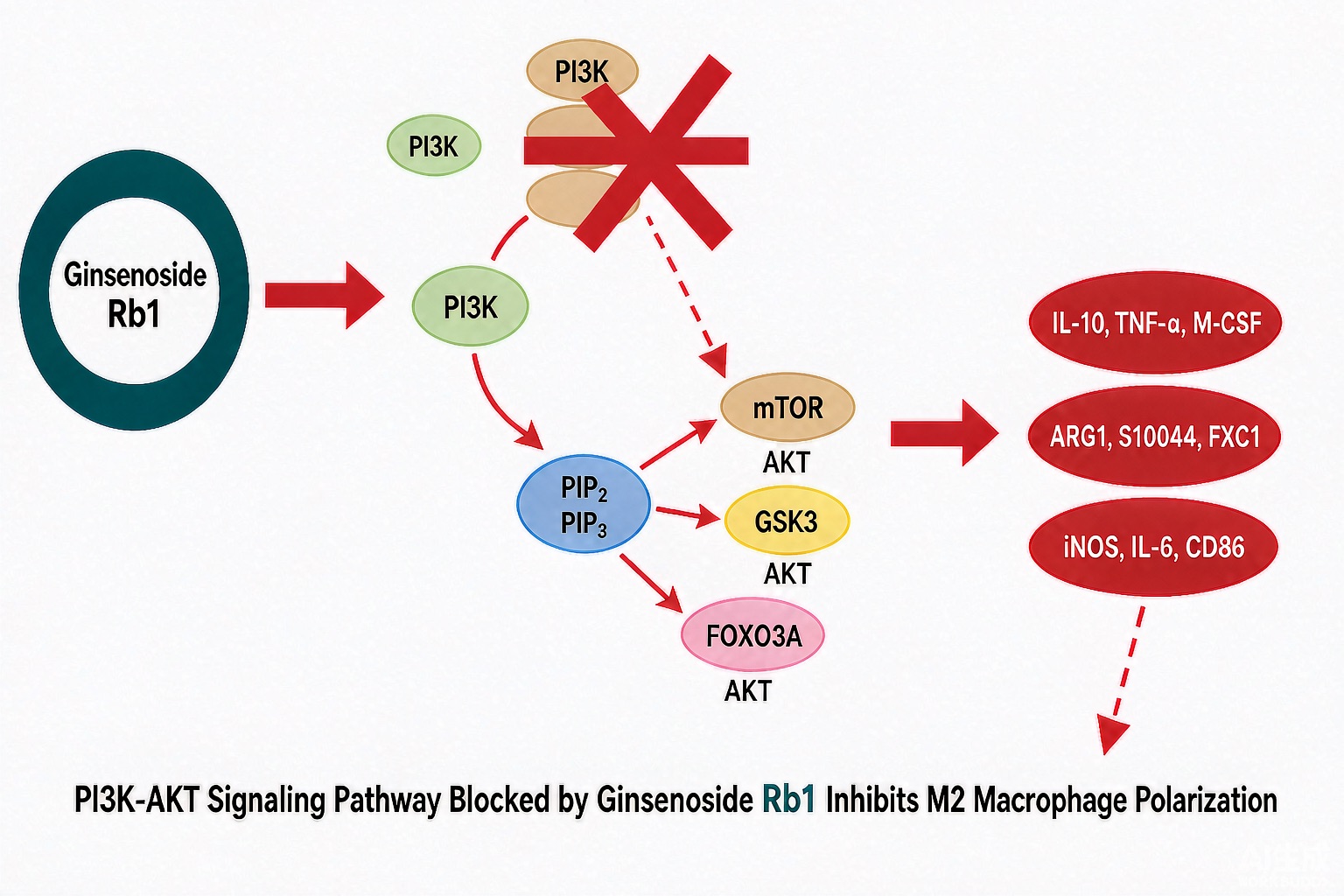
The PI3K-AKT pathway is a central intracellular signaling axis. When PI3K (phosphoinositide 3-kinase) is activated, it generates lipid messengers that recruit AKT to the cell membrane, where AKT becomes phosphorylated and active. Active AKT then influences a wide range of downstream targets involved in cell growth, metabolism, and survival.
In macrophage biology, this pathway is frequently discussed as one of the regulators that can tilt cells toward an M2-like profile. Think of it as a dimmer switch rather than an on/off button—small adjustments in signaling can produce meaningful changes in cellular behavior over time.
Ginsenoside Rb1 is a protopanaxadiol-type saponin and one of the most abundant ginsenosides in ginseng root. It has drawn attention in cell and animal research for its interactions with inflammatory signaling and for its influence on how immune cells respond to their environment.
Laboratory studies have reported that Rb1 can modulate the PI3K-AKT axis in various cell models. In the context of macrophages, research has examined whether Rb1—acting on this pathway—can influence the balance between different polarization states, including the M2 profile. The emerging picture suggests that Rb1 may act less as a blunt suppressor and more as a modulator, nudging signaling in a direction that supports resolution rather than sustained activation.
It is important to be precise here: these are mechanistic observations from controlled experiments, often in vitro or in animal models. They illuminate a possible route of inquiry, not a clinical outcome in humans. The science is promising and still unfolding.
For anyone drawn to traditional Chinese medicine and natural wellness, this line of research offers a kind of bridge. Traditional frameworks describe ginseng as a harmonizing root—one that supports the body's capacity to adapt. Modern investigation into macrophage polarization and PI3K-AKT signaling offers a parallel way of imagining that harmony at the cellular level.
At TCM Global, we find this convergence meaningful not because it promises a quick fix, but because it encourages a slower, more respectful relationship with botanicals: understanding what is known, what is still being studied, and where caution belongs.
If you already enjoy ginseng as part of a wellness ritual, look for products that are clearly sourced and simply described—whole roots, teas, or gently prepared supplements taken according to their labels. Traditional use often emphasizes moderation: small, regular amounts incorporated into a routine, rather than intensive bursts.
If you are taking medication or managing a health condition, speak with a qualified healthcare professional before adding any botanical to your regimen. Herbs, like any active substance, deserve that care.
Ginsenoside Rb1 and its relationship with the PI3K-AKT pathway and M2 macrophage polarization represent one of the more fascinating meeting points between traditional herbal wisdom and contemporary immunology. The research is early, the mechanisms are nuanced, and the story is worth following attentively. For now, the most mindful response is a quiet one: curiosity, moderation, and respect for the body's own capacity for balance.
Explore more Eastern-inspired wellness insights at tcm-global.net.
Explore more Eastern wellness wisdom at TCM Global.