← Back to TCM Global · All articles
2026-10-20
For centuries, ginseng has held a place of honor in Eastern wellness traditions—a root valued for restoring vitality and supporting the body's own resilience. Today, the laboratory is catching up with what practitioners have long sensed. Recent investigations into ginseng compound Rb1, a prominent ginsenoside, are drawing attention to how this botanical may interact with the complex cellular environment surrounding pancreatic tumors—particularly the macrophages that tumors recruit as allies.
This article explores the emerging science with care and clarity, honoring both the tradition behind ginseng and the rigor of modern inquiry. It is offered as wellness education, not medical guidance.
A tumor is not merely a cluster of rogue cells. It exists within a living ecosystem—the tumor microenvironment—comprising blood vessels, immune cells, connective tissue, and signaling molecules. Among the most influential residents of this ecosystem are tumor-associated macrophages (TAMs).
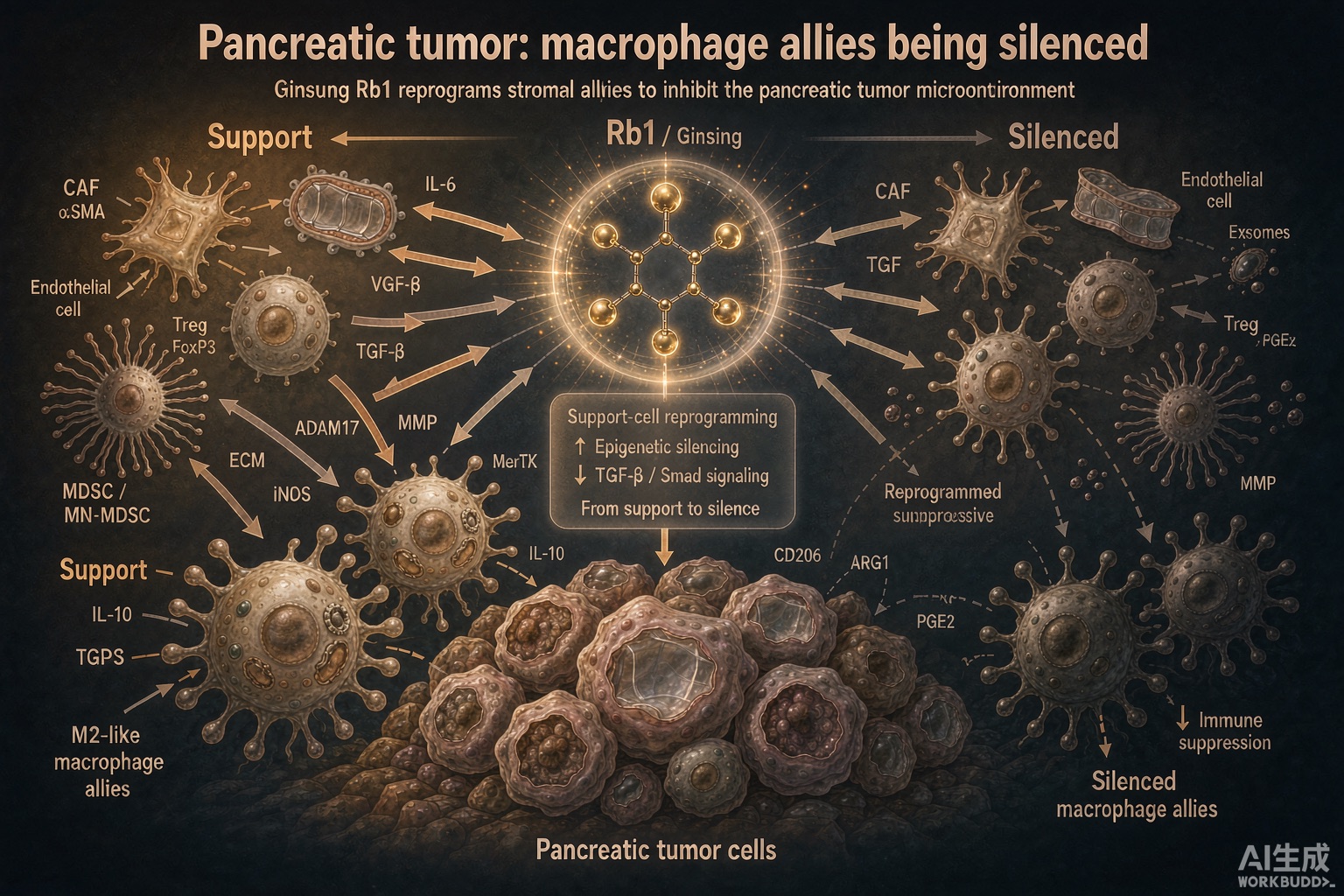
Macrophages are the body's cleanup crew, normally tasked with engulfing debris and coordinating immune responses. In the presence of certain tumors, however, they can be coaxed into a submissive state—sometimes called M2 polarization—where instead of attacking, they nurture. They suppress local immune vigilance, promote blood vessel formation, and help tumors secure nutrients. In pancreatic cancer, one of the most challenging malignancies, these reprogrammed macrophages form a dense, protective fortress around the tumor.
Ginsenosides are the signature active constituents of ginseng, and Rb1 is among the most studied. It belongs to the protopanaxadiol family and has been examined for its interactions with immune signaling pathways. In traditional frameworks, ginseng is understood to "tonify the qi"—supporting the body's foundational energy and defensive capacity. Modern science offers a complementary lens: certain ginsenosides appear to influence how immune cells communicate.
Recent laboratory work has begun to examine whether Rb1 can influence the behavior of tumor-associated macrophages in pancreatic cancer models. The findings, while early, are intriguing.
Importantly, this research is largely preclinical—conducted in cells and animal models. It represents a direction of inquiry rather than a clinical conclusion. Yet it adds a compelling chapter to the ongoing conversation between traditional botanicals and modern immunology.
Pancreatic tumors are notoriously resistant to treatment, in part because their microenvironment is so fortified. The dense stromal barrier and the abundance of tumor-supportive macrophages make this cancer a particularly urgent focus. Research into agents that can gently modulate this environment—rather than attack tumor cells directly—reflects a broader shift in oncology toward understanding the ecosystem as a whole. Ginseng Rb1 is one of several natural compounds being explored in this context.
There is a quiet elegance in this convergence. Traditional Chinese Medicine has always viewed health as the harmonious interplay of systems—not the isolated targeting of a single flaw. The concept of supporting the body's terrain so that imbalance cannot take root resonates with modern interest in the tumor microenvironment.
Ginseng, in this light, is not a weapon but a harmonizer. Its constituents are studied not for aggressive action but for their capacity to influence the conversation between cells—to restore balance where disease has cultivated disorder.
For those drawn to ginseng as part of a wellness lifestyle, the research offers a reminder of the root's depth—but also of the need for patience and perspective. Ginseng has been consumed for generations as a tonic, often in teas, soups, or standardized extracts. Its place is in daily nourishment and preventive care, not as a substitute for medical treatment.
Quality matters. TCM Global sources ginseng with attention to cultivation, processing, and ginsenoside profile, so that each preparation honors both tradition and transparency. Whether as a warming decoction in cooler months or a measured extract in a morning routine, ginseng's role is to support vitality—quietly, consistently, and with respect for the body's own intelligence.
Science continues to unfold the ginseng story, one compound at a time. Rb1's interaction with tumor-associated macrophages is a promising thread, but it is one thread in a vast tapestry. What remains constant is the root's enduring place in wellness traditions—a testament to the idea that nature offers allies in the pursuit of balance.
As research advances, we at TCM Global will continue to share developments with calm curiosity, always distinguishing between the promise of inquiry and the certainty of practice. For wellness seekers, ginseng remains a faithful companion—rooted in ancient soil, reaching toward modern understanding.
Explore more Eastern wellness wisdom at TCM Global.