← Back to TCM Global · All articles
2026-10-20
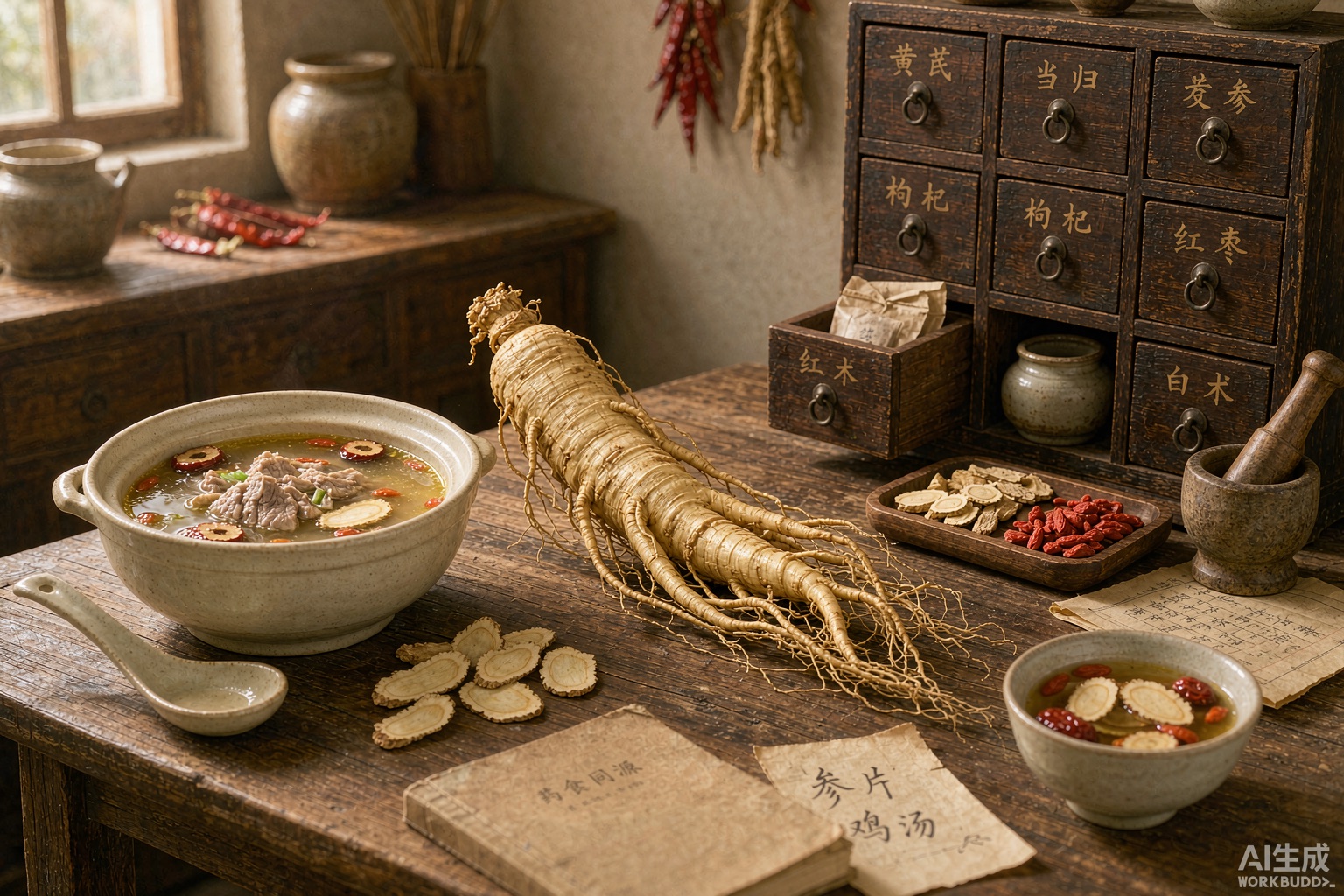
In the classical Chinese wellness tradition, some ingredients were never really classified as "medicine" at all. They sat on the kitchen shelf next to rice and ginger — foods that also happened to nourish and support the body. This idea is known as medicine-food homology: the recognition that certain everyday ingredients belong simultaneously to the larder and to the herbal cabinet.
The premise is gentle rather than dramatic. Instead of waiting for something to go wrong, you build resilience slowly, through what you eat and drink each day. This is a food-first approach to wellbeing — not a substitute for medical care, but a philosophy of everyday nourishment. And within that philosophy, few botanicals embody the idea as gracefully as ginseng.
Ginseng has been a daily tonic in East Asia for centuries, often steeped in tea, simmered in broth, or chewed in thin slices — methods that feel closer to cooking than to treatment. This matters for the concept of nutrition-based prevention, which favors ingredients you can integrate into ordinary routines rather than reserve for moments of need.
The American approach to nutraceuticals tends to isolate single compounds. The herbal tradition mostly doesn't. It values the whole root, its balance, and the ritual of taking it consistently. But modern research has offered a bridge between the two: a growing interest in identifying which specific constituents in ginseng are most associated with its wellness-supporting profile. That bridge is where Rb1 enters the conversation.
Ginsenosides are the characteristic compounds found in ginseng, and Rb1 is among the most studied of them. It belongs to a class that researchers continue to examine in the context of overall wellbeing, cellular resilience, and healthy daily function — genuine science, approached with appropriate humility.
What makes Rb1 interesting from a homology viewpoint isn't hype; it's *fit*. It reflects the idea that a food-like botanical can carry genuine substance. In ginseng, the compounds aren't an afterthought added to a wellness product; they're the natural constituents of a root people have simmered in soup for generations. Rb1 simply gives us a clearer lens through which to appreciate what the whole plant has always offered.
This is where careful sourcing and modern processing earn their place. A supply chain that respects the root's integrity — starting from cultivation and applied through gentle extraction — helps preserve its fuller spectrum of compounds. That is the difference between a botanical that feels complete and one reduced to an extract's shadow.
If nutrition-based prevention has a signature, it's consistency. A handful of daily habits, carried over months and years, tends to accomplish more than short bursts of intensity. In this spirit, ginseng is best approached as a quiet companion rather than a rescue remedy.
Consider how the traditional pantry treated it:
The point is not intensity but rhythm — a small, repeatable act of nourishment that aligns with the body's appetite for gradual support.
It's worth stating clearly what ginseng is and isn't. It won't replace sleep, movement, or medical advice. Concerns about supplementation, drug interactions, or specific health conditions belong in conversation with a qualified practitioner — especially for those who are pregnant, managing a health condition, or taking medication.
The value here is measured. This is about a calmer, more intentional approach to everyday food choices, in which a storied botanical plays a small, well-understood role. Modest claims, met with modest expectations, is how the homology tradition has always preferred to travel.
Medicine-food homology endures because it asks us to feed the body rather than merely fix it. Ginseng Rb1 brings a specificity to that idea — a recognizable, researched constituent within a root that sits comfortably in the kitchen. The old tradition offers the philosophy; modern research offers a clearer view of what makes the root distinctive. Together, they point toward a quiet, sustainable pattern of everyday prevention.
The final variable is the root itself. Region, age at harvest, cultivation practice, and processing all shape a ginseng's character and compound profile. A calm, premium approach means treating those details with the same care the tradition reserves for the herb — a plant entrusted with a long legacy of daily nourishment. Healthy rituals are built on quality foundations.
The language of science and the language of tradition don't need to argue. A warm cup, a familiar root, and a willingness to choose nourishment daily — that's the whole of it. Not a shortcut. Not a promise. Just food, in its wisest form.
Explore more Eastern wellness wisdom at TCM Global.