← Back to TCM Global · All articles
2026-10-20
For centuries, ginseng has held a place of honor in Eastern wellness traditions—an adaptogen, a tonic for vitality, a companion to those seeking balance through changing seasons of health. Modern science has begun to look closely at the individual compounds within this storied root, and one in particular has drawn the attention of researchers: ginsenoside Rb1.
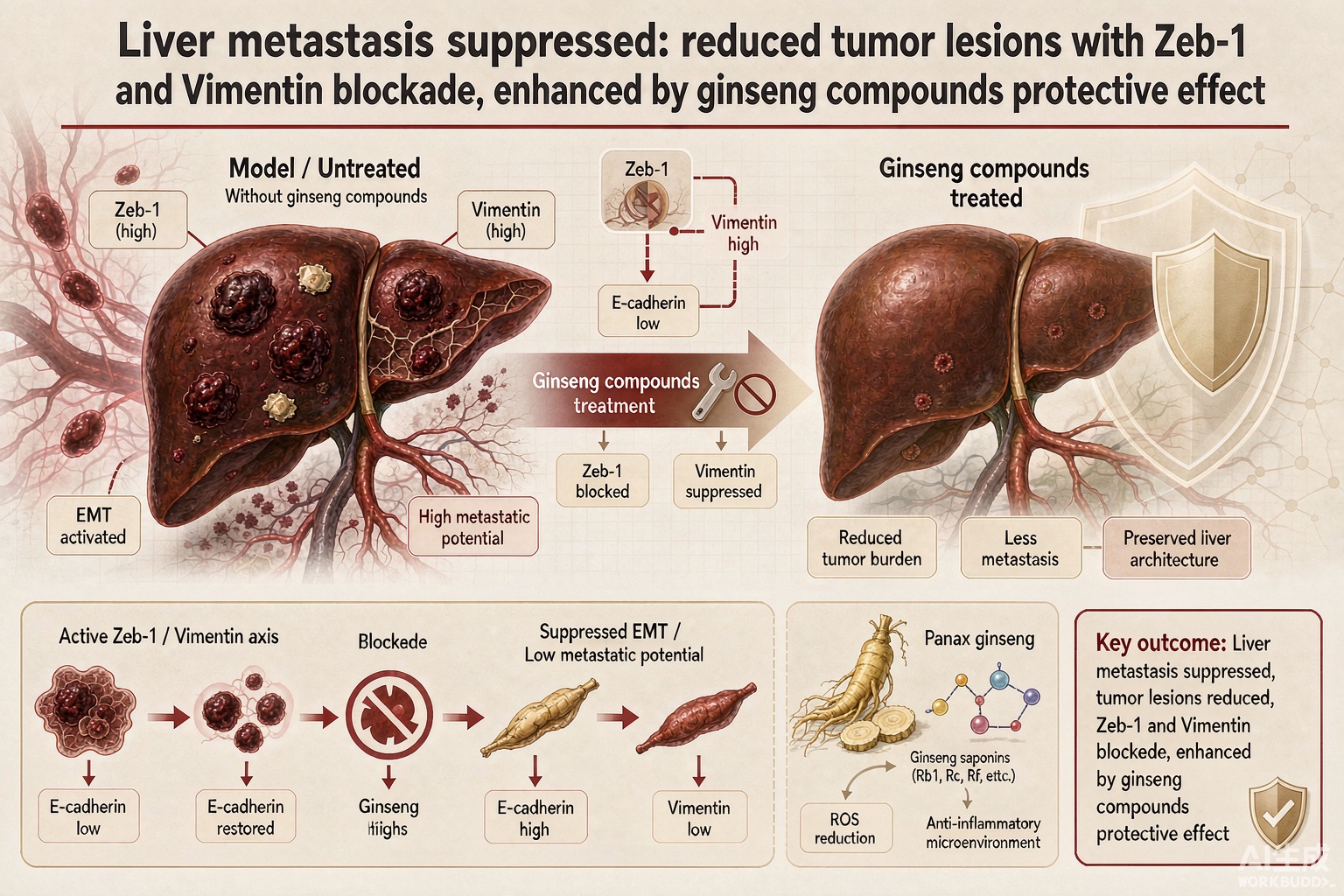
Recent laboratory exploration has examined how Rb1 may relate to pathways associated with liver metastasis, specifically its apparent influence on Zeb-1 and vimentin—two markers often discussed in the study of cellular movement. This is early, cell-level science, not a prescription or a promise. But it offers a fascinating lens on why a root valued for so long continues to interest modern investigators.
To appreciate this conversation, a few quiet definitions help. Zeb-1 is a transcription factor studied in relation to epithelial-mesenchymal transition (EMT)—a process researchers use to describe how cells change character and mobility. Vimentin is a structural protein often discussed alongside that transition. In laboratory settings, scientists observe whether certain compounds influence these markers.
Studies at the cellular level have reported that ginsenoside Rb1 may help modulate the expression of Zeb-1 and vimentin in certain tested cell lines. In plain terms, researchers are asking whether Rb1 encourages a more settled, less mobile cellular profile. The findings are preliminary and confined to the lab—an invitation to curiosity, not a clinical conclusion.
The liver carries a unique burden and a singular grace in traditional and modern health alike. It filters, stores, and harmonizes—the body's quiet chemist. In TCM, the liver governs the smooth flow of qi, and its health is understood as woven into emotion, rest, and nourishment. This Eastern view and the Western study of liver pathways meet in interesting places, particularly when researchers examine compounds like Rb1 and their relationship to cellular behavior in hepatic tissue.
That convergence is not proof of anything in the clinical sense, but it is a meaningful dialogue between traditions. It reminds us that wellness is not one language spoken by one discipline, but an ongoing exchange.
It is important to hold this research with a calm and honest hand. Ginseng Rb1 and its relationship to Zeb-1 and vimentin are laboratory observations. They do not constitute medical advice, treatment, or evidence of benefit for any health condition. Anyone navigating a health concern should work with qualified medical professionals—no supplement replaces sound clinical care.
What the research does offer is a gentle reinforcement of a long-held idea: that the roots and herbs of traditional practice deserve careful scientific attention. For wellness-minded individuals, the takeaway is perspective—an appreciation for how science continues to interrogate the botanical wisdom of the East.
At TCM Global, we believe in presenting traditional botanicals with restraint and respect. Our approach to ginseng is grounded in sourcing integrity, traditional understanding, and an honest acknowledgment of what research can and cannot say. Ginseng has been used for generations as a vitality tonic within an overall pattern of balanced living—not as a remedy for disease.
If ginseng is part of your wellness ritual, consider it as one thread in a larger fabric: quality sleep, nourishing food, mindful movement, and regular check-ins with your healthcare practitioner. A premium root deserves a considered context.
Science is slowly building a vocabulary to describe what tradition has long sensed—that plants carry compounds worthy of dignity and study. Ginsenoside Rb1's appearance in discussions of Zeb-1 and vimentin is one small chapter in that larger story. It is not a headline cure; it is a question worth asking, and a reminder that curiosity, paired with humility, is the most honest wellness posture of all.
We will continue to watch this research with quiet interest and to share what emerges—clearly, carefully, and without overstatement.
Explore more Eastern wellness wisdom at TCM Global.