← Back to TCM Global · All articles
2026-10-19
For many people, spring and autumn arrive not as a relief but as a quiet ordeal: the tickle at the back of the throat, the morning sneezing, the eyes that itch before the day has properly begun. Allergic rhinitis is one of the most common wellness complaints in the world, and it has a way of wearing down even the most patient among us.
In traditional Chinese medicine, this pattern has long been understood not as a war against pollen, but as a matter of the body's defensive Qi losing its rhythm. And among the herbs most revered in that tradition, ginseng has stood at the center for centuries. Now, modern research is giving us a new way to think about why.
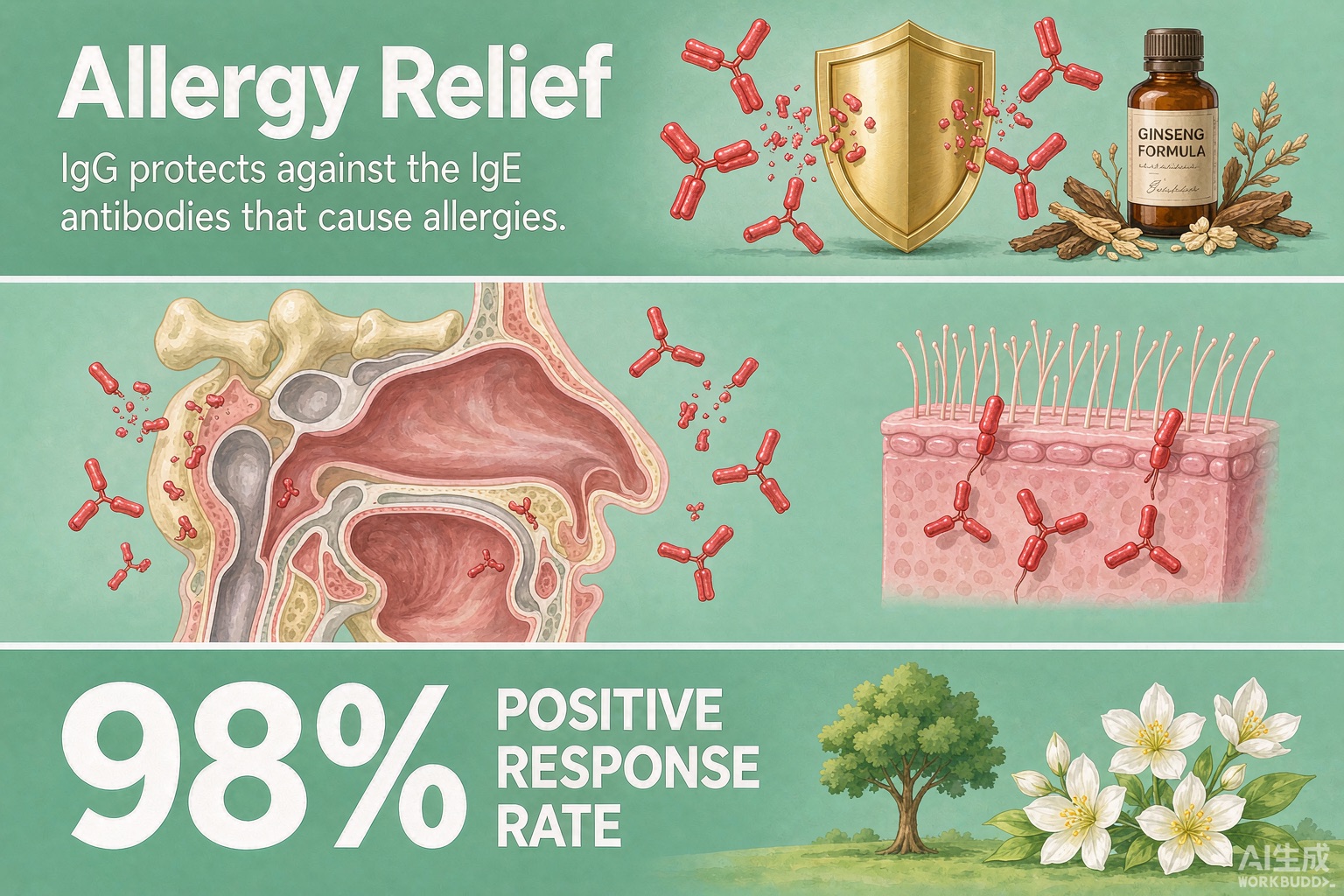
A widely discussed study on a ginseng-based formula reported a striking figure: a 98 percent response rate among participants dealing with allergic rhinitis. For anyone who has shuffled through a season of antihistamines, that number understandably catches the eye.
But it is worth pausing, as any careful reader of wellness research should. A high response rate in a single trial describes what happened in that specific group under that specific protocol — it is not a promise of the same result for every person. Response, too, must be defined: it may mean reported symptom relief rather than a measurable clinical endpoint. The responsible reading is that this is a promising signal worth following, not a finish line.
Still, the finding invites a genuinely interesting question: what mechanism might connect ginseng to seasonal discomfort at all?
When the immune system misidentifies something harmless — pollen, dust, dander — as a threat, it produces immunoglobulin E, or IgE. IgE is the antibody that arms mast cells, and when it binds, those cells release histamine. Histamine is what you feel: the swelling, the itching, the sneezing.
The research framing around this ginseng formula centers on the idea of modulating that IgE pathway — calming the over-eager immune signaling rather than suppressing it outright. In the language of TCM, this is not so different from what practitioners have described for generations: restoring balance to the defensive Qi so the body stops overreacting to the ordinary world.
It is a beautiful convergence of old and new — the same idea, told in the vocabulary of antibodies and in the vocabulary of Qi.
Ginseng — particularly Panax ginseng and its gentler cousin American ginseng — has long been classified in TCM as a Qi tonic. It is the herb you reach for when reserves feel depleted, when the constitution needs steady support rather than a sharp push. Its ginsenosides are the compounds modern researchers most often study, and they are the subject of ongoing interest in immune balance and seasonal comfort.
In classical formulas, ginseng was rarely used alone. It was balanced with other herbs — often ones selected for the specific pattern of the person in front of the practitioner. This matters for how we read any formula study at all: the result belongs to the combination, the preparation, and the people in it.
If you are drawn to ginseng as part of your own seasonal wellness routine, a few grounded habits serve you better than enthusiasm:
And a necessary note: allergic rhinitis can be serious, and ginseng can interact with certain medications. This is wellness writing, not medical advice — please speak with your own healthcare professional before adding any herb, especially if you take blood thinners or immune-related prescriptions.
The 98 percent figure is a door, not a destination. It points toward something genuinely worth exploring — the idea that a revered tonic herb may quietly influence the very antibody pathway behind seasonal suffering. At TCM Global, we find that possibility both humbling and hopeful.
Perhaps that is the oldest lesson of all: the body is not trying to defeat the season. With the right support, it is trying to remember how to live with it.
Explore more Eastern wellness wisdom at TCM Global.