← Back to TCM Global · All articles
2026-10-30
# Forest-Grown Ginseng Understory Premium Meaning for Buyers
Forest-grown understory ginseng refers to root cultivated under natural forest canopy from seed, usually for 10 years or longer, without tilling, fertilizers, or pesticides — and its premium price of roughly 3-10 times farm-grown ginseng reflects slower growth, higher ginsenoside concentration, and limited supply. For B2B buyers, the term is powerful but also loosely used, so understanding what it technically means — and how to verify it — protects both sourcing budgets and brand claims.
Ginseng divides into three broad categories, and "forest grown" sits deliberately between the other two:
| Category | Growing method | Typical age at harvest | Relative price | Ginsenoside level |
|---|---|---|---|---|
| Field-cultivated (farm grown) | Tilled beds, shade cloth, fertilization; 4-6 year rotation | 4-6 years | 1x (baseline) | Moderate |
| Forest-grown / understory (wild-simulated) | Seed sown under natural forest canopy, no agrochemicals, minimal interference | 10-20+ years | 3-10x | High |
| True wild ginseng | Germinates naturally, untouched | 20-50+ years | 10-50x+ | Very high, variable |
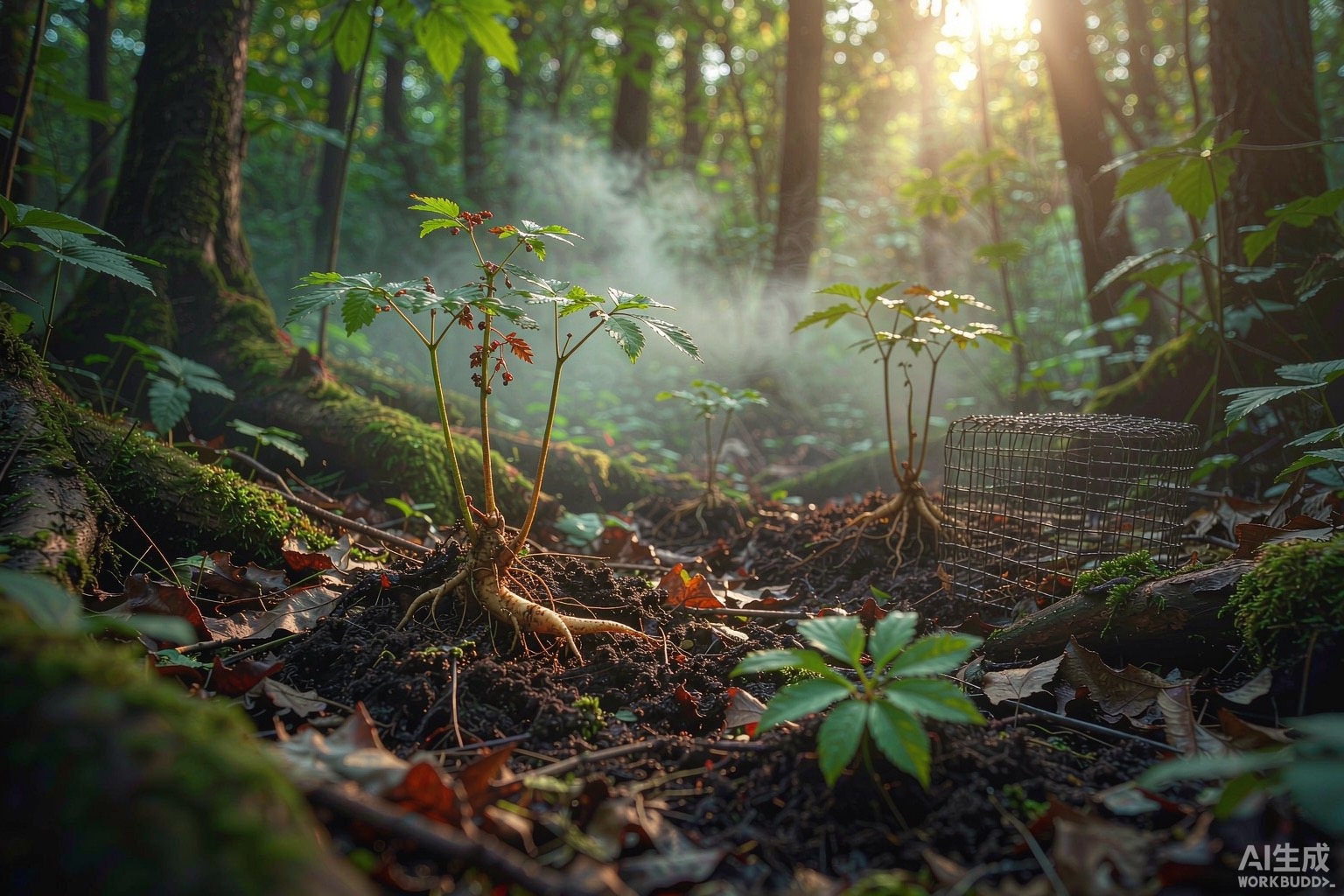
The understory method, sometimes called wild-simulated cultivation, works by scattering seed in suitable deciduous forest — in China, primarily the Changbai Mountain region of northeast Jilin province — and letting nature run the process. Survival rates are low (a large share of seeds never reach maturity), the root grows slowly and densely in stressed conditions, and annual production volumes are a tiny fraction of farm-cultivated output. Scarcity plus chemistry drives the premium. Our Changbai Mountain origin story covers the region's growing conditions in detail.
Slower growth under canopy stress changes the root's composition. Industry analyses generally report that long-aged forest roots test meaningfully higher in total ginsenosides than 4-6 year farm roots — often in the range of 2-4% by dry weight versus roughly 1-2% for younger cultivated root — with a ginsenoside profile that shifts toward the more valued minor ginsenosides as age increases. The root morphology also differs: understory roots are smaller, more elongated, with tight growth rings and a more developed rootlet system, which is why age verification relies partly on "neck" (rhizome) ring counting.
For product formulation, this chemistry matters in specific ways: a smaller dose of forest-grown extract can carry the same ginsenoside load as a larger dose of farm extract, and premium-positioned finished goods — gift sets, high-end vials — justify their retail prices with this story. See our technical explainer on ginsenoside content and what Rg1/Rb1 mean for the lab context.
Because the term carries no single international standard, verification is your responsibility. A defensible sourcing package includes:
Expect wide price bands by age and quality: dried understory root has traded in ranges from roughly USD 150-600 per kg for 10-15 year material to USD 1,000-3,000+ per kg for older, well-formed roots, with true wild material far above that. Finished-product premiums compound: a forest-grown gift set can retail at 3-5 times an equivalent farm-grown set, especially in East Asian and Middle East gifting channels — see our ginseng wholesale price per box guidance for finished-goods benchmarks. Because lots are heterogeneous, buyers should sample the actual lot, not "equivalent" stock, and tie payment terms to lot verification.
In the US and EU, understory ginseng is a differentiator but a claims-sensitive one. Safe framing emphasizes cultivation method, age, and origin ("sustainably grown under forest canopy for 15 years in the Changbai Mountains"), and sustainability angles — no agrochemicals, forest preserved rather than cleared — resonate strongly with premium wellness buyers. Avoid treatment-adjacent claims; the premium story should rest on rarity, purity, and craft, in line with the compliance tone expected of finished ginseng products entering Western retail.
It means ginseng grown from seed under a natural forest canopy, typically for 10 or more years, without tilling, fertilizer, or pesticides — a wild-simulated method. The slow, stressed growth concentrates ginsenosides and creates the small, dense root that commands a premium of roughly 3-10 times farm-grown root.
Request named forest-base origin documents, harvest year, and the basis for age determination (rhizome ring counting by a qualified assessor), plus third-party lab tests confirming high ginsenoside levels and near-undetectable pesticide residues. Cross-check that root size and morphology plausibly match the claimed age, and insist on sampling the actual lot.
No. Wild ginseng germinates and grows entirely naturally, often for 20-50+ years, and trades at the highest prices. Forest-grown (wild-simulated) root is intentionally seeded and minimally managed by humans — chemically closer to wild than to farm root, but a distinct and much more available category.